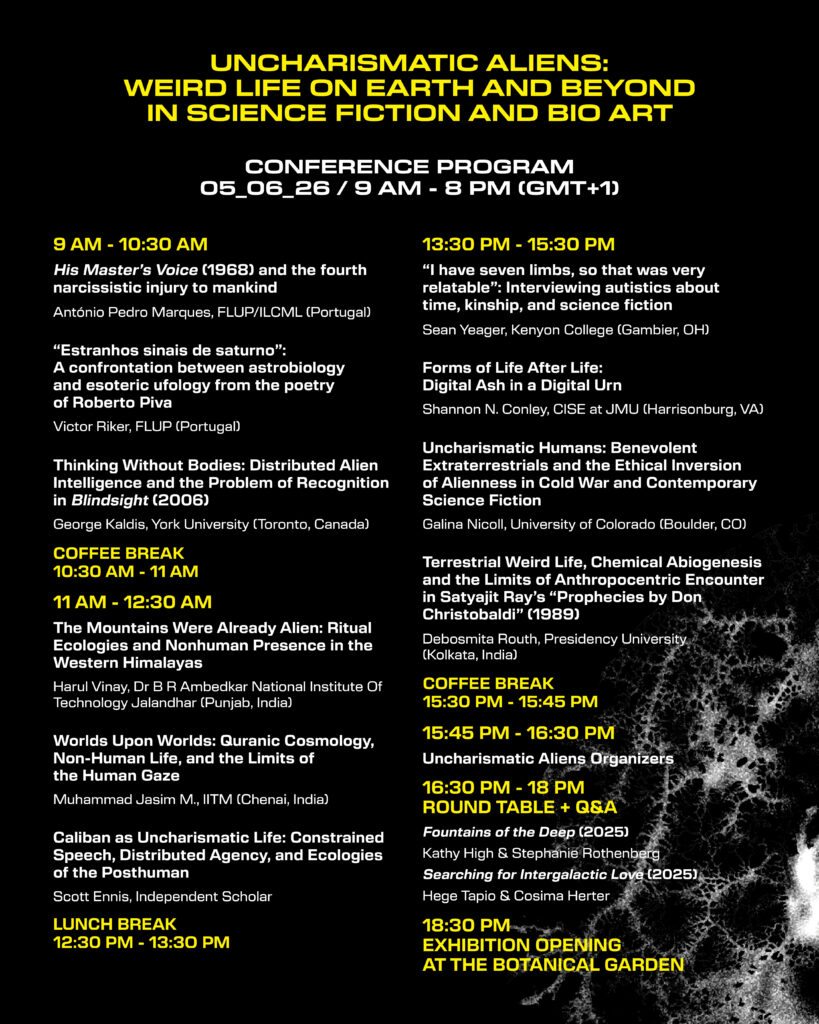
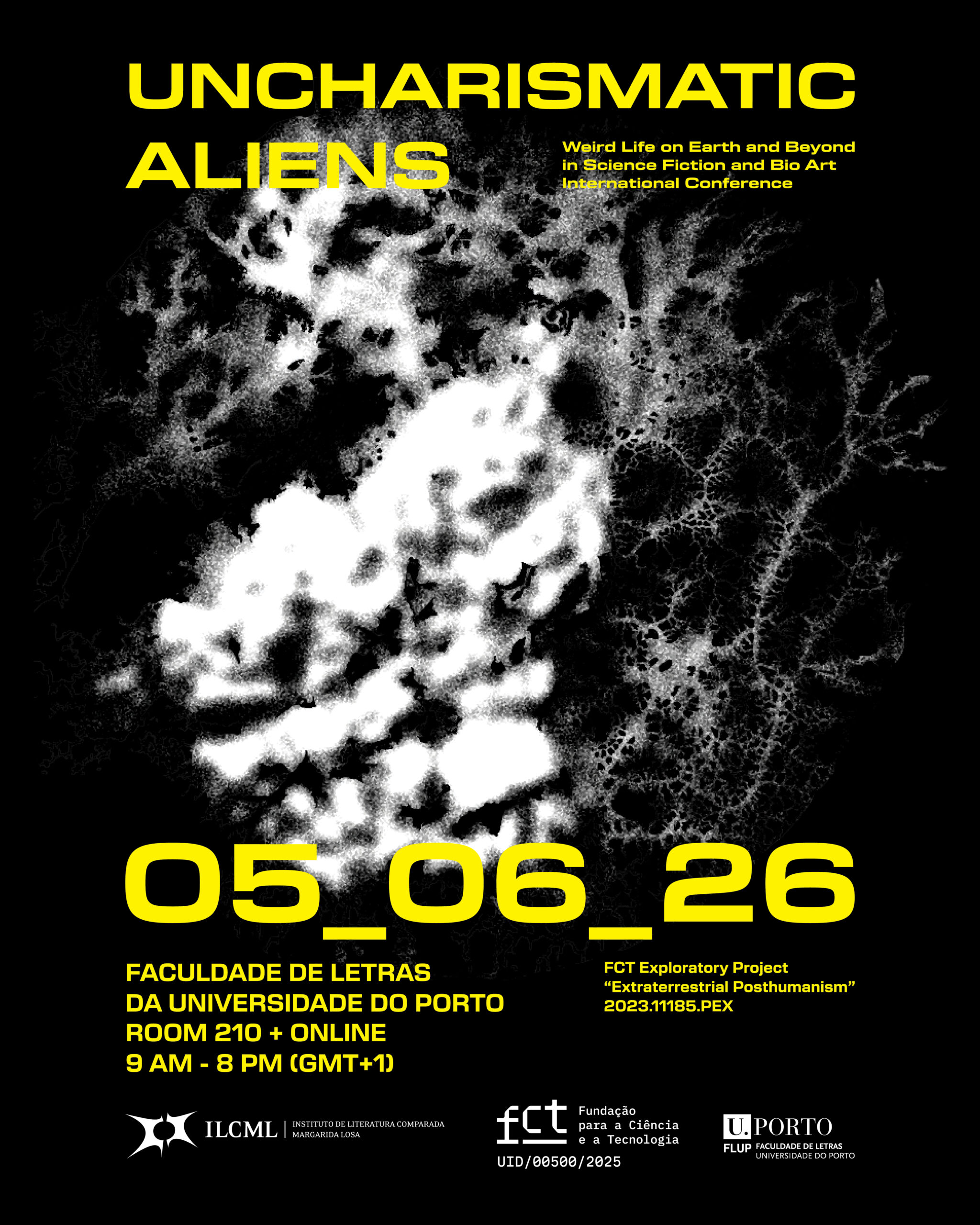
UNCHARISMATIC ALIENS:
WEIRD LIFE ON EARTH AND BEYOND
IN SCIENCE FICTION AND BIO ART
In recent decades, the scientific search for extraterrestrial life has undergone a significant conceptual transformation. Earlier astrobiological research largely focused on identifying environments similar to those on Earth — particularly the presence of water and organic molecules — as indicators that life might exist elsewhere in the universe. Increasingly, however, scientists recognize that truly alien life may not resemble terrestrial biology at all. Rather than searching only for “life as we know it”, astrobiologists now explore the possibility that organisms could arise from unfamiliar biochemical systems, rely on alternative solvents, or take forms that challenge our current definitions of life.
This shift has important cultural implications. At first glance, the idea of radically different forms of life might evoke the spectacular aliens of popular science fiction. Yet scientific discussions of extraterrestrial life often point toward organisms that are far less dramatic and far more difficult to recognize. Many possible forms of life — whether on Earth or on other planets — may appear strange, subtle, or difficult to interpret from a human perspective. They may lack recognizable morphology, visible activity, or the kinds of behaviors that make organisms legible and appealing to human observers. In this sense, much life may be “uncharismatic”: alien not because it is monstrous or spectacular, but because it does not easily fit within human expectations of what life should look like or how it should behave.
At the same time, Earth itself is already home to an extraordinary diversity of unfamiliar and often overlooked organisms and life systems. From unusual microbial communities and extremophiles to symbiotic networks and unconventional biological structures, terrestrial
life frequently challenges anthropocentric assumptions about individuality, perception, agency, and ecological organization. Paying attention to such forms of life can help us rethink what counts as “alien”, revealing that the strange and unfamiliar are not confined to distant planets but are already present within the biosphere of our own world.
This conference takes the notion of uncharismatic aliens as a starting point for exploring weird and unfamiliar life forms both on Earth and beyond it. Bringing together scholars, artists, and researchers from across the humanities, sciences, and arts, the event will examine how science fiction, speculative thought, and contemporary artistic practices engage with organisms that resist familiar biological and cultural categories. Such life forms may be microscopic or macroscopic, biological or quasi-biological, individual or ecological, perceptible or largely invisible to human senses.
A particular interest of the conference lies in the potential of Bio Art and related artistic practices to render strange forms of life perceptible and experientially accessible. By giving visual, material, or sensory form to living systems that might otherwise remain abstract or hidden, such works can create new ways of encountering unfamiliar organisms and environments. Through installations, performances, and interdisciplinary collaborations, art may offer powerful means of engaging with forms of life that challenge conventional ideas about biological value, species hierarchy, and human centrality.
The conference will also accompany the exhibition of newly commissioned Bio Art works responding to the theme of strange and uncharismatic life. Together, these artistic and scholarly contributions aim to broaden our understanding of biological diversity, extraterrestrial possibility, and the limits of human imagination.
ORGANIZING COMMITTEE
João Paulo Guimarães
Ana P. H. Salvan
Lizzie Smith
Inês de Caldas Martins