

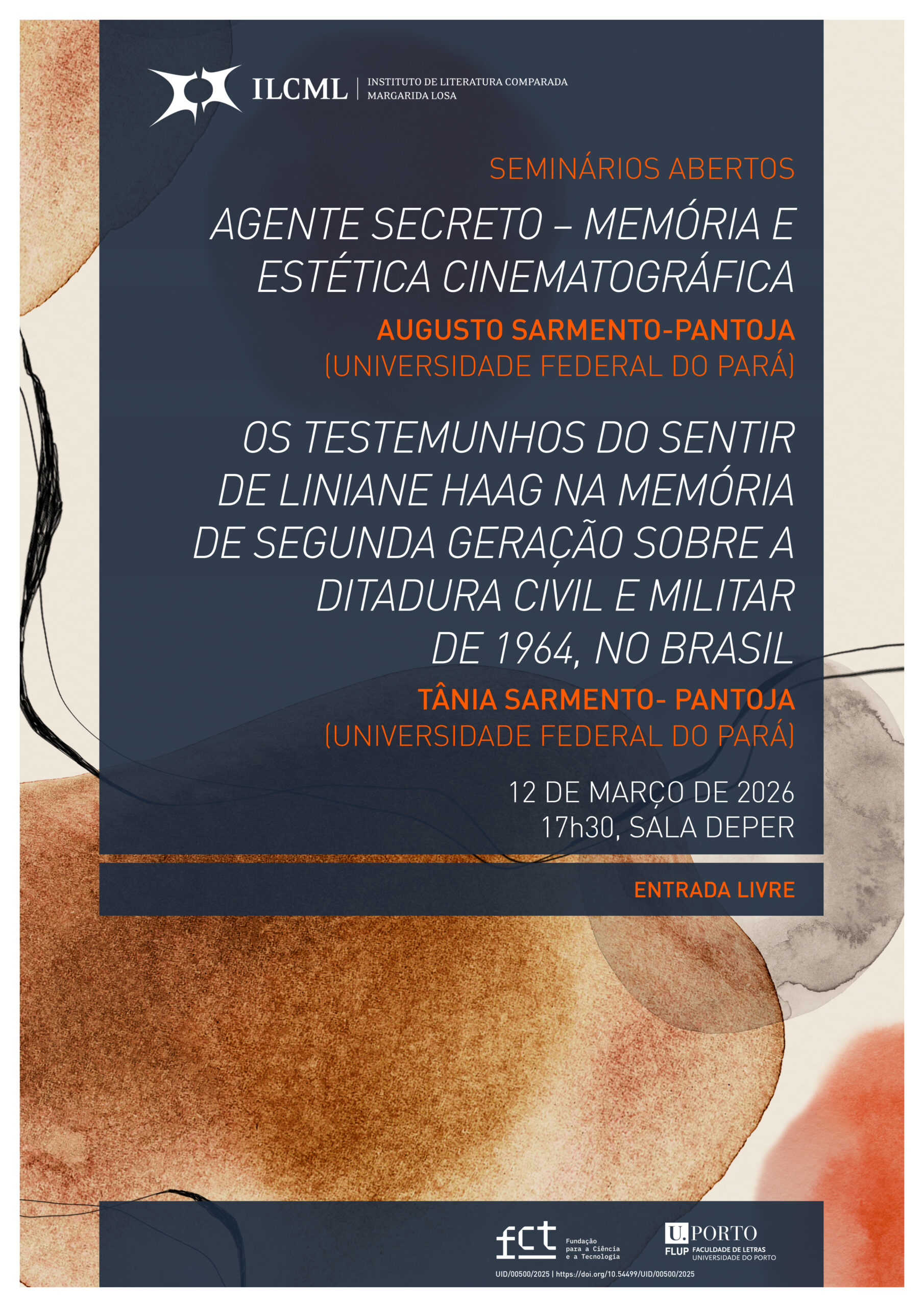
Secret Agent – Memory and cinematic aesthetics
Abstract: Secret Agent (2025), directed by Kleber Mendonça Filho and starring Wagner Moura, is a film set in the city of Recife in 1977, during the Brazilian civil-military dictatorship. The plot introduces us to Armando/Marcelo (Wagner Moura), a university professor and researcher at UFPE’s Department of Technology, responsible for obtaining patents and developing, among other things, a prototype electric car and a leather-processing machine. However, the researcher is forced to go underground due to persecution by businesses and the dictatorial regime that sought to steal his research. The researcher is accused of corruption and alleged crimes, ‘Embezzling public funds intended for research,’ according to the newspaper at the time, reporting his death.
*
Carlos Augusto Nascimento Sarmento-Pantoja is an Associate Professor II at the Federal University of Pará, teaching at the Faculty of Arts and the Postgraduate Programme in Arts. PDS and DES scholarship holder from CNPq. He coordinates the Narratives and Visualities Laboratory and the Cine Clube ‘Resistências’ project. Leader of the Aesthetics, Performances and Hybridism Research Group (ESPERHI) and the Resistance Narratives Studies Group (NARRARES).
***
Liniane Haag’s testimonies in the second generation’s memory of the 1964 civil and military dictatorship in Brazil
Abstract: We intend to present an analysis of two productions strongly committed to the formats of testimony: Antes do Passado – o silêncio que vem do Araguaia (2012), by Liniane Haag Brum, a production related to the memory of resistance to the 1964 Civil and Military Dictatorship established in Brazil. In Antes do Passado – o silêncio que vem do Araguaia, Brum recounts her search for her uncle, Cilon Cunha Brum, a combatant in the Araguaia Guerrilla Movement, from the 1960s until Cilon’s disappearance in the 1970s. The production has non-specificity as a reference, especially due to the hybridity of forms and narrative fragmentation; learning about an affective object; and, finally – this is our hypothesis – the composition of a testimony of feeling.
*
Tânia Maria Pereira Sarmento-Pantoja is Professor at the Federal University of Pará, teaching at the Faculty of Arts and Humanities and the Postgraduate Programme in Literature. She is a CNPq Research Productivity Fellow. She coordinates the Narratives and Visualities Laboratory and the Cine Clube ‘Resistências’ project. She is the leader of the Resistance Narratives Studies Group (NARRARES).